
PRODUCTS
• AGM have been actively auditing companies for Quality, Safety, Environment and other certifications in the Asia region.<br>
• We have a team of qualified, experienced auditors who understand the industry as well as our customers.
• Training professionals to understand and apply various ISO requirements to their organization in various industries.
• We have a blend of theory and practical training techniques.
• We have conducted risk assessment for organizations to understand their risk and actions needed to address them; and deriving opportunities at the same time.
CERTIFICATIONS
https://agm.digita.com.my/energy-management-system-iso-50001/
ISO 9001:2015 is a globally recognized standard for quality management. It helps organizations of all sizes and sectors to improve their performance, meet customer expectations and demonstrate their commitment to quality. Its requirements define how to establish, implement, maintain, and continually improve a quality management system (QMS).
Implementing ISO 9001:2015 means your organization has put in place effective processes and trained staff to deliver flawless products or services time after time. It is suitable for organizations of any size, and applies to all sectors, including manufacturing, services, healthcare, education, government, and non-profit organizations. ISO 9001 can also be used by certification bodies or other third parties to assess an organization’s conformity with this International Standard.
Benefits of ISO 9001:2015
- Increased customer trust and satisfaction
- Sound quality control processes
- Cost savings and productivity gains
- Culture of continuous improvement
ISO 14001:2015 specifies the requirements for an environmental management system that an organization can use to enhance its environmental performance. ISO 14001:2015 is intended for use by an organization seeking to manage its environmental responsibilities in a systematic manner that contributes to the environmental pillar of sustainability.
ISO 14001:2015 helps an organization achieve the intended outcomes of its environmental management system, which provide value for the environment, the organization itself and interested parties.
Benefits of ISO 14001:2015
- Enhancement of environmental performance
- Fulfilment of compliance obligations
- Achievement of environmental objectives
ISO 45001:2018 specifies requirements for an occupational health and safety (OH&S) management system, and gives guidance for its use, to enable organizations to provide safe and healthy workplaces by preventing work-related injury and ill health, as well as by proactively improving its OH&S performance.
ISO 45001:2018 is applicable to any organization that wishes to establish, implement and maintain an OH&S management system to improve occupational health and safety, eliminate hazards and minimize OH&S risks (including system deficiencies), take advantage of OH&S opportunities, and address OH&S management system nonconformities associated with its activities.
Benefits of ISO 45001:2018
- Continual improvement of OH&S performance;
- Fulfilment of legal requirements and other requirements;
- Achievement of OH&S objectives.
The consequences of unsafe food can be serious. ISO’s food safety management standards help organizations identify and control food safety hazards, at the same time as working together with other ISO management standards, such as ISO 9001:2015. ISO 22000:2018 provides a layer of reassurance within the global food supply chain, helping products cross borders and bringing people food that they can trust.
ISO 22000:2018 sets out the requirements for a food safety management system and can be certified to it. It maps out what an organization needs to do to demonstrate its ability to control food safety hazards in order to ensure that food is safe. ISO 22000:2018 is applicable to all organizations in the food and feed industries, regardless of size or sector.
Benefits of ISO 22000:2018
- The ability to consistently provide food-related products and services that are safe and meet regulatory requirements
- Improved management of risks in food safety processes
Designed to support organizations in all sectors, this ISO 50001:2018 standard provides a practical way to improve energy use, through the development of an energy management system (EnMS).
ISO 50001:2018 is based on the management system model of continual improvement also used for other well-known standards such as ISO 9001:2015 or ISO 14001:2015. This makes it easier for organizations to integrate energy management into their overall efforts to improve quality and environmental management.
Benefits of ISO 50001:2018
- Develop a policy for more efficient use of energy
- Fix targets and objectives to meet the policy
- Use data to better understand and make decisions about energy use
- Measure the results
- Review how well the policy works
- Continually improve energy management
Transparency and trust are the building blocks of any organization’s credibility. Nothing undermines effective institutions and equitable business more than bribery.
ISO 37001:2016 is the International Standard that allows organizations of all types to prevent, detect and address bribery by adopting an anti-bribery policy, appointing a person to oversee anti-bribery compliance, training, risk assessments and due diligence on projects and business associates, implementing financial and commercial controls, and instituting reporting and investigation procedures.
ISO 37001:2016 can be used by any organization, large or small, whether it be in the public, private or voluntary sector and in any country. It is a flexible tool, which can be adapted according to the size and nature of the organization and the bribery risk it faces.
Benefits of ISO 37001:2016
- Minimum requirements and supporting guidance for implementing or benchmarking an anti-bribery management system
- Assurance to management, investors, employees, customers, and other stakeholders that an organization is taking reasonable steps to prevent bribery
- Evidence in the event of an investigation that an organization has taken reasonable steps to prevent bribery.
ISO 21001:2018 specifies requirements for a management system for educational organizations (EOMS) when such an organization:
- a) needs to demonstrate its ability to support the acquisition and development of competence through teaching, learning or research;
- b) aims to enhance satisfaction of learners, other beneficiaries and staff through the effective application of its EOMS, including processes for improvement of the system and assurance of conformity to the requirements of learners and other beneficiaries.
All requirements of ISO 21001:2018 are generic and intended to be applicable to any organization that uses a curriculum to support the development of competence through teaching, learning or research, regardless of the type, size or method of delivery. ISO 21001:2018 can be applied to educational organizations within larger organizations whose core business is not education, such as professional training departments.
Benefits of ISO 21001:2018
- Increased credibility of the educational organization
- Enhanced social responsibility by providing inclusive and equitable quality education for all
- More personalized learning and effective response to all learners, in particular those with special education needs and distance learners
- Consistent processes and evaluation tools to demonstrate and increase effectiveness and efficiency
ISO 26000:2010 for businesses and organizations committed to operating in a socially responsible way. It provides guidance to those who recognize that respect for society and environment is a critical success factor. As well as being the “right thing” to do, application of ISO 26000:2010 is increasingly viewed as a way of assessing an organization’s commitment to sustainability and its overall performance.
ISO 26000:2010 provides guidance rather than requirements, so it cannot be certified to unlike some other well-known ISO standards. Instead, it helps clarify what social responsibility is, helps businesses and organizations translate principles into effective actions and shares best practices relating to social responsibility, globally. It is aimed at all types of organizations regardless of their activity, size or location.
Benefits of ISO 26000:2010
- The ability to attract and retain workers or members, customers, clients and users
- The maintenance of employee morale, commitment and productivity
- The perception of investors, owners, donors, sponsors and the financial community
- Relationships with companies, governments, the media, suppliers, customers and the community in which it operates
ISO 13485:2016, Medical devices Quality management systems, requirements for regulatory purposes, is an internationally agreed standard that sets out the requirements for a quality management system specific to the medical devices industry.
ISO 13485:2016 helps an organization design a quality management system that establishes and maintains the effectiveness of its processes. It reflects a strong commitment to continual improvement and gives customers confidence in its ability to bring safe and effective products to market.
ISO 13485:2016 is designed to be used by organizations involved in the design, production, installation and servicing of medical devices and related services. It can also be used by internal and external parties, such as certification bodies, to help them with their auditing processes.
Benefits of ISO 13485:2016
- Demonstrate compliance with regulatory and legal requirements
- Ensure the establishment of QMS practices that consistently yield safe and effective medical devices
- Manage risk effectively
- Improve processes and efficiencies as necessary
With cyber-crime on the rise and new threats constantly emerging, it can seem difficult or even impossible to manage cyber-risks. ISO/IEC 27001:2022 helps organizations become risk-aware and proactively identify and address weaknesses.
ISO/IEC 27001:2022 promotes a holistic approach to information security: vetting people, policies and technology. An information security management system implemented according to this standard is a tool for risk management, cyber-resilience and operational excellence.
The ISO/IEC 27001:2022 standard provides companies of any size and from all sectors of activity with guidance for establishing, implementing, maintaining and continually improving an information security management system.
Benefits of ISO 27001:2022
- Reduce your vulnerability to the growing threat of cyber-attacks
- Respond to evolving security risks
- Provide a centrally managed framework that secures all information in one place
- Secure information in all forms, including paper-based, cloud-based and digital data
- Save money by increasing efficiency and reducing expenses for ineffective defence technology
ISO 22301:2019 is useful for business continuity and risk professionals, supply chain directors, audit managers and associates, developers of corporate social responsibility reports, regulatory bodies and anyone else involved or interested in business continuity. ISO 22301 also gives a clear and detailed view of how an organization operates, offering valuable insights that are useful for strategic planning, risk management, supply chain management, business transformation and resource management.
ISO 22301:2019 is aligns with many other internationally recognized management system standards, such as ISO 9001 (quality management) and ISO 14001 (environmental management). As such, it is designed to be integrated into an organization’s existing management processes.
ISO 22301:2019 is applicable to all organizations, regardless of size, industry or nature of business. It is also relevant to certification and regulatory bodies as it enables them to assess an organization’s ability to meet its legal or regulatory requirements.
Benefit of ISO 22301:2019
- Help organizations respond to, and recover from, disruptions effectively
- Reduced costs and less impact on business performance
- The ability to reassure clients, suppliers, regulators and other stakeholders that the organization has sound systems and processes in place for business continuity
- Improved business performance and organizational resilience
- A better understanding of the business through analysis of critical issues and areas of vulnerability
Good Manufacturing Practices or GMP is a system that consists of processes, procedures and documentation that ensures manufacture of food products are consistently produced and controlled according to set quality standards. Implementing GMP can help cut down on losses and waste, avoid recall, seizure and fines.
Good Manufacturing Practices (GMPs) based on MS 1514 is the Malaysia national standard that quite similar Codex Alimentarious requirements. It is part of a qualiy system requirements for manufacture of food products and other food chains. The GMPs contain requirements for hygienic and cleanliness practices and other good manufacturing practices that enhance food safety.
The GMPs are the pre requisites that serve as a foundation that complement the HACCP management system.
Benefits of GMP:
- Simplified in obtaining export certificates such as the Free Sales Certificate, GMO Certificate, and others
- Strengthen and support other quality assurance systems such as ISO, HACCP and HALAL.
- Able to compete with other countries in the global food market
- Ensuring food industry complies with standards at both domestic and overseas
Hazard Analysis Critical Control Point (HACCP) is the internationally recognized food safety system that focuses on the systems required to identify and control the potential risks of food-borne safety hazards from reaching consumers. It is suitable for any organization who involved directly or indirectly in the food chain such as farms, fisheries, dairies, meat processors, and food service providers such as restaurants, hospitals, and catering services.
Malaysian Standard MS 1480 published by Department of Standards to describe the requirements for food safety according to the Hazard Analysis and Critical Control Point (HACCP) system to ensure the safety of food during preparation, processing, manufacturing, packaging, storage, transportation, distribution, handling or offering for sale or supply in any sector of the food chain.
HACCP principles specify requirements for food safety system where an organization in the food chain needs to demonstrate its ability to control food safety hazards in order to ensure that food is safe at the time of human consumption.
Benefits of HACCP:
- One of the requirements in obtaining No.EU for export purpose to the EU.
- Made easy to get export certificates such as the Free Sales Certificate, GMO Certificate, Heat Process Meat Certificate and others.
- Strengthen and support other quality assurance systems such as ISO and HALAL.
- Able to compete with other countries in the global food market.
PROCESS
• Training professionals to understand and apply various ISO requirements to their organization in various industries
• We have conducted risk assessment for organizations to understand their risk.
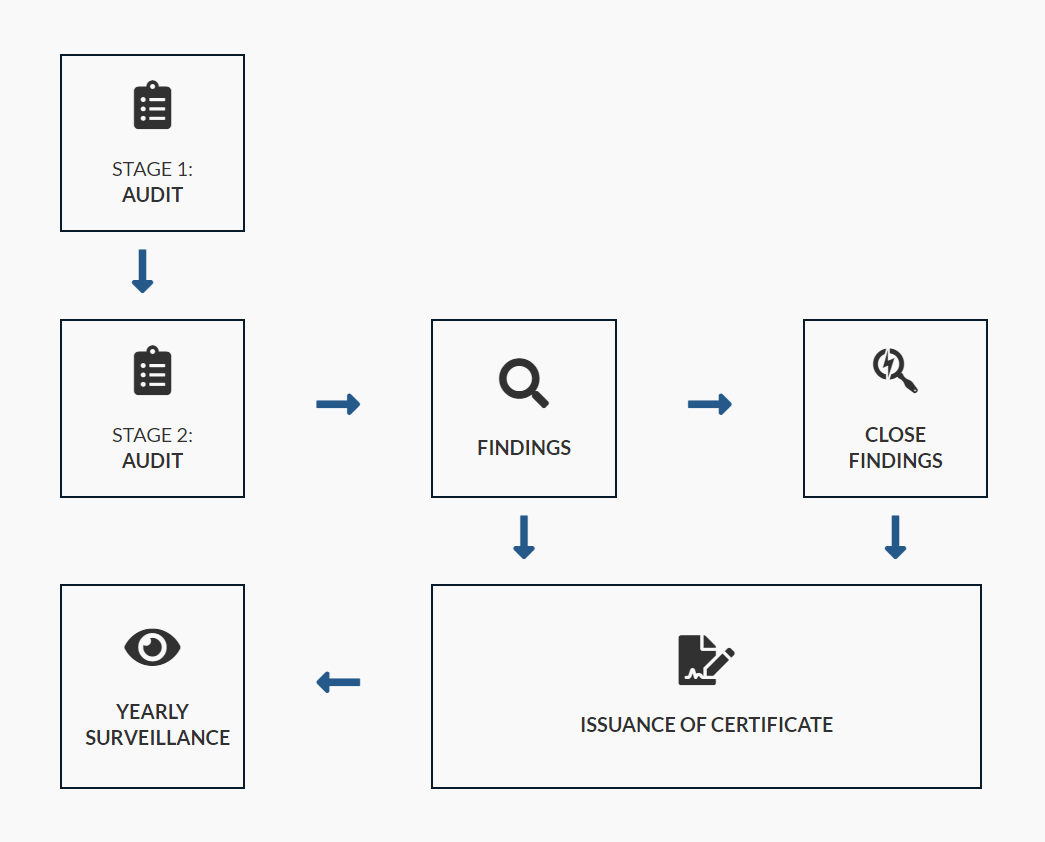
STAGE 1: AUDIT
STAGE 2: AUDIT
Findings
Close Findings
yearly surveillance
ISSUANCE OF CERTIFICATE
PROCESS